

Raj Thomas helps iGaming operators, startups, and game developers grow through strategic partnerships, compliant gaming solutions, lead generation, and business development.
(TL;DR)
The foundation of every online casino game depends on one critical technology: RNG or Random Number Generator. Whether a player spins a slot reel, receives a blackjack card, or waits for a roulette ball to land, the result is determined by an RNG system running silently in the background.
For casino operators, RNG is not just a technical component. It is the backbone of fairness, compliance, and trust. Without a properly implemented and certified RNG system, no online casino can operate legally in regulated markets.
As the iGaming industry becomes more competitive and transparent, RNG technology has evolved from simple randomization algorithms to highly secure cryptographic and hardware-based systems. Today, RNG plays a central role in licensing approvals, game certification, player retention, and platform scalability.
This guide provides a deep, operator-focused understanding of RNG in casino games, how it works, why it matters, and how it is implemented in modern gaming systems.

RNG stands for Random Number Generator, a mathematical or computational system designed to produce unpredictable outcomes.
In casino gaming, RNG determines every result that appears in a digital game environment. It replaces physical randomness used in land-based casinos, such as shuffled cards or spinning wheels, with algorithmic randomness.
In practical terms, RNG controls:
Every action triggered by a player is processed through RNG logic, ensuring that outcomes cannot be predicted or influenced.
Unlike simple random functions used in basic software, casino RNG systems must meet strict statistical fairness standards defined by gaming regulators.
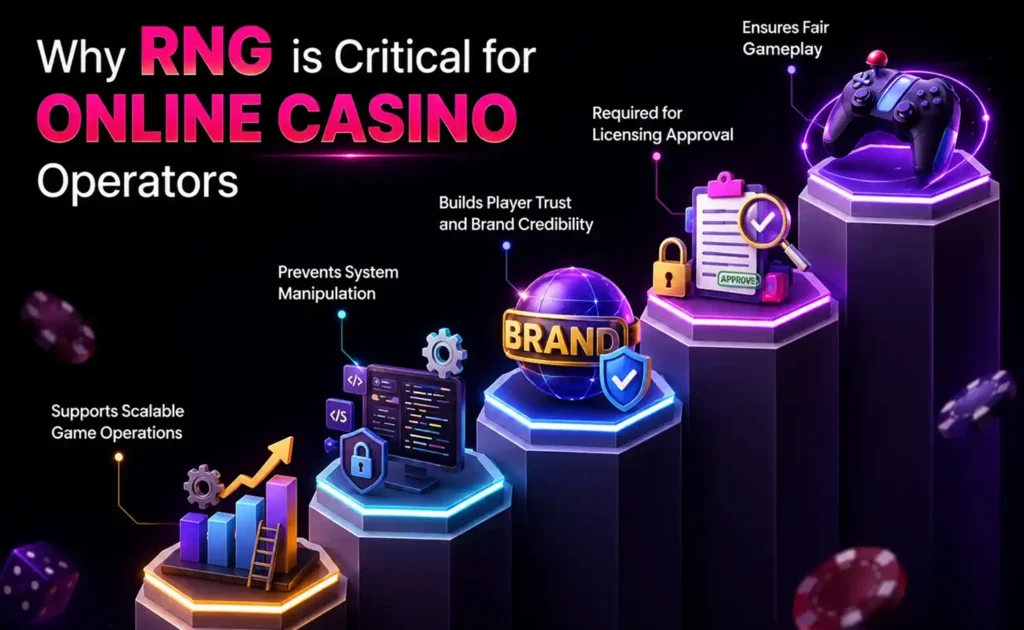
For casino operators, RNG is one of the most important systems in the entire gaming architecture. It directly affects compliance, trust, revenue stability, and platform reputation.
RNG guarantees that every player has an equal chance of winning. Outcomes are generated independently of previous results, player behavior, or betting patterns.
This ensures:
Fairness is the foundation of all regulated gambling systems.
Almost every gaming regulator requires certified RNG systems before granting an iGaming license.
Authorities such as:
All require independent verification of RNG fairness before approving casino operations.
Without RNG certification, a casino platform cannot legally launch in regulated markets.
Modern players are highly aware of fairness concerns in online gambling. RNG certification acts as a trust signal that the platform is legitimate.
Players are more likely to:
Trust directly impacts revenue growth in the iGaming industry.
A properly implemented RNG system ensures that neither operators nor players can control or predict outcomes.
This protects the platform from:
Security and randomness are tightly connected in casino architecture.
RNG systems allow casinos to handle millions of game rounds simultaneously without manual intervention.
This is essential for:
Scalability is a major requirement for enterprise casino operators.
At its core, RNG systems generate a continuous stream of random numbers that are mapped to game outcomes.
A simplified process looks like this:
Player Action → RNG System Generates Number → Game Engine Maps Result → Outcome Displayed
However, in real casino systems, this process is more complex and involves multiple layers of validation and synchronization.
RNG systems start with a seed value, which may come from:
The seed ensures that every RNG sequence starts uniquely.
Using mathematical algorithms, the system generates a large sequence of pseudo-random numbers.
These numbers are generated extremely fast—often thousands per second—even when no player is actively interacting with the game.
The generated number is then mapped to a game outcome.
For example:
This mapping ensures randomness translates into gameplay results.
The final outcome is displayed to the player through the game interface, animations, and UI systems.
This entire process happens within milliseconds.
Casino operators use different RNG models depending on game architecture, compliance requirements, and technology stack.
PRNG is the most commonly used system in online casinos.
It uses deterministic algorithms to simulate randomness.
Characteristics:
Common usage:
Although PRNG is not truly random, it is statistically unpredictable when properly designed.
TRNG systems generate randomness using physical phenomena.
Sources include:
Characteristics:
TRNG is often used in high-security or specialized gaming environments.
Cryptographic RNG is widely used in crypto casinos and Web3 gaming platforms.
It relies on:
Characteristics:
This model is becoming increasingly popular in modern decentralized casino ecosystems.
RNG is applied differently depending on the game structure.
RNG determines:
RNG simulates:
RNG handles:
RNG ensures:
RNG generates:
Before casino games can go live, RNG systems must be certified by independent testing agencies.
Certification involves detailed evaluation of:
Once approved, RNG systems receive certification required for licensing compliance.
Casino platforms generally use two fairness models.
Both models ensure fairness but differ in transparency levels.
In licensed systems, RNG is independently tested and cannot be manipulated.
Each RNG result is independent of previous results.
Streaks are statistical occurrences, not system manipulation.
Casino operators may face several technical and regulatory challenges.
Each jurisdiction has unique RNG certification requirements.
RNG must operate instantly without affecting gameplay speed.
Poor implementation may lead to exploitation attempts.
RNG must work seamlessly with game engines, wallets, and backend systems.
RNG technology continues to evolve alongside blockchain and AI innovation.
Improves transparency and verifiability.
Detects fraud patterns and improves system security.
Combine PRNG, TRNG, and cryptographic methods for maximum reliability.
For B2B casino businesses, RNG is not optional—it is foundational.
It directly affects:
Without RNG compliance, no casino platform can operate in regulated markets.
RNG is a system that generates random results in casino games to ensure fairness and unpredictability.
It produces statistically random outcomes that cannot be predicted or controlled by players or operators.
Certified RNG systems are real and tested by independent regulators for fairness and compliance.
In licensed casino systems, RNG is secured and cannot be manipulated.
Slots, roulette, blackjack, poker, crash games, and most online casino games use RNG systems.
RNG is centralized and certified, while provably fair systems are blockchain-based and verifiable by players.
It is required for regulatory approval, player trust, and legal casino operations.

TIGGames provides secure & scalable casino game development solutions ready for global markets.
© 2026 TIGGames | All Rights Reserved | Sitemap | Privacy Policy
Request A Demo
Get a quick look at your potential earnings. Answer four simple questions and see your projected revenue for year one.
Keep in mind, this quick analysis is a preliminary guideline meant to kickstart your detailed market research. Best of luck!
Enter your email to receive your full cost breakdown, including projected net revenue, operating margin, and editable line items for your own planning.
Your inputs are used only to generate and deliver your report and are handled in line with TIGCasino's Privacy Policy.