

Prish K is an iGaming expert with 8+ years' experience empowers operators with scalable sportsbook, casino, sweepstakes, and prediction market solutions.
(TL;DR)
The global online casino market was valued at USD 19.1 billion in 2024 and is expected to reach USD 23.9 billion in 2026, growing further to USD 38.0 billion by 2030 at a CAGR of 12.2% between 2025 and 2030. Europe held the largest market share in 2024, contributing approximately 48% of global revenue. The growth of the online casino industry is mainly fueled by rising smartphone adoption, improved internet connectivity, and increasing access to digital gambling platforms worldwide.
Building a real-money casino game is a multi-layered engineering process where math modeling, regulatory constraints, backend architecture, and long-term performance tuning carry as much weight as visuals or gameplay.
The decisions made for RTP, volatility, and system design shape the game experience, determine how quickly a game gets certified, how it integrates into platforms, and whether it generates sustained revenue.
This casino game development guide is written for operators, product managers, and founders who need a clear, end-to-end view of how to develop casino games properly, from initial concept to post-launch optimization.
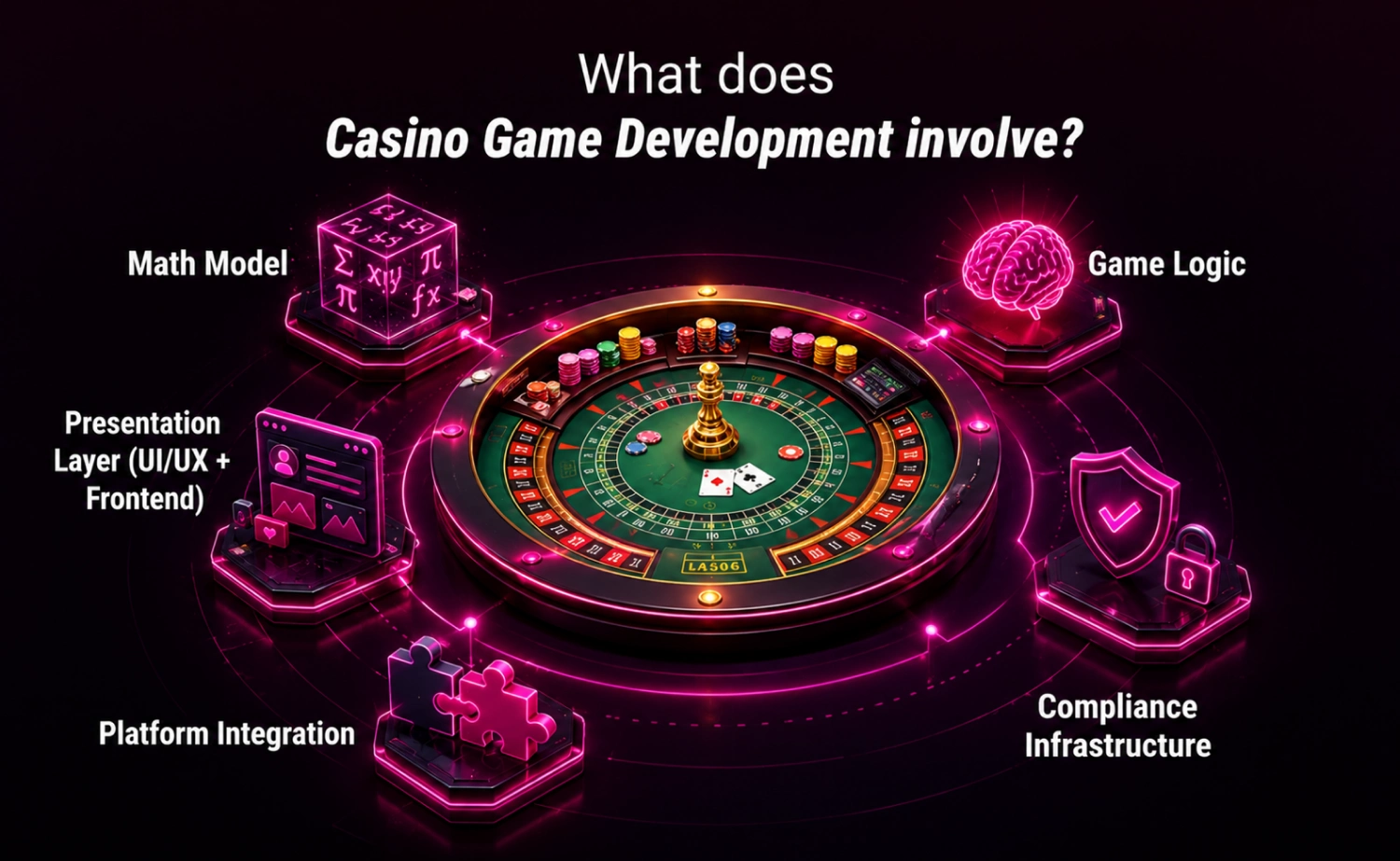
Game type is a creative and structural decision. The category of casino game type you choose determines math complexity, certification scope, infrastructure requirements, and even how quickly a title can generate revenue.
Most operators make the mistake of going with what’s popular in the industry today. Fewer evaluate what their platform, budget, and target market can realistically support.
Slots are the backbone of modern iGaming portfolios for a reason: they are infinitely configurable at the math level and scalable across markets. From a casino game development narrative, slot games are defined by:
With slot games, things differ with the range of complexity, where a basic 3-reel slot is relatively straightforward to build, but a feature-heavy video slot, which has multiple bonus states and progressive elements, becomes a multi-layer system.
Slot games dominate the casino gaming space because
At the same time, this dominance creates pressure as new entrants are competing in a saturated category where math quality and feature execution determine performance.
At a surface level, table games look simpler because the math is simplified and executable blackjack probabilities, roulette distributions, and baccarat rules. The complexity of these table games comes from;
Table game players expect consistency and speed, not feature experimentation; hence, the UX must prioritize clarity over engagement mechanics.
Live dealer is not an extension of table games; it’s a separate product category with its own infrastructure stack.
These might be difficulties for startup casino operators, but if built right, the same live games can be the core differentiator for your online casino. However, you must decide whether to build live dealer games in-house or integrate with a third-party provider, and how you want to manage streaming infrastructure, in-house or rely on external platforms.
From a casino game software development standpoint, the challenge shifts from math modeling to systems reliability and latency control.
This category is gaining traction rapidly, particularly among younger player segments, and the core characteristics to take care of in casino game development steps are;
Crash games have a simpler frontend and game flow while laying high emphasis on backend fairness logic and verification systems. Moreover, these games also have a tight coupling between multiplier curves and risk exposure.
The trap here is assuming simplicity equals low risk. These games rely heavily on trust signals; any perceived inconsistency in outcomes can damage player confidence quickly.
As per experts, the casino game development guide, the starting point for your casino games shouldn’t be trends, but rather depend on constraints. Here’s how to make a decision.
| Budget | Target Market |
|
|
| Regulatory Environment | Platform Readiness |
|
|
Most casino operators start with slot game development, because that is the default choice for many
However, slots are not always the right choice because if differentiation is critical, entering a saturated slot market without a strong math or feature strategy means you need to compete with the already established casinos.
Moreover, if infrastructure is limited, even a moderately complex slot can become difficult to maintain, and when the target audience is table-focused, a slot-first approach delays traction.
When you begin to learn how to build casino games from scratch, always begin with the math model as it defines.
Your choices for RTP and volatility will make a difference in how a casino game development company approaches the build process. For instance, RTP of 96% and high volatility mean longer losing streaks, less frequent but larger payouts, and bonus features must carry significant reward weight.
What does this affect further in the development process:
Math model errors discovered late cost 3–4x more to fix because at that point, they are embedded in logic, UI flows, and certification assumptions.
Choose the architecture and tech stack to define scalability and maintainability. The frontend casino game development handles rendering, interaction, and animation. Backend casino game development is about controlling outcomes, session integrity, and data logging.
A casino game’s UX is nothing like an application UX or a software UX, as the priority here is not exploration or feature showcase, but its clarity and speed. So, for a casino game UX, the hierarchy matters.
You lose grip on any of these, and conversion drops almost immediately.
Another decision you need to make is between mobile-first vs mobile-adaptive, and in online casino game development, mobile-first is the baseline expectation.
Then comes sound design, which needs to reinforce outcomes, as in, win sounds increase perceived reward, and loss pacing influences session duration.
This is the phase when all the planning and design is stitched together through core components, like;
The development stage needs to prepare the platform for interruption sessions, failed transactions, currency variations, and regulatory logging. This phase determines whether the game can operate reliably in a live environment, not just function in isolation.
Internal QA and testing ensure the game works as intended without any performance lags and security lapses. Only after proper testing should you apply for certification to ensure the casino game is legally deployable.
There are three main testing labs in the industry, GLI, eCOGRA, and iTech Labs, and these evaluate the following;
Some of the most common failure points that you must consider when understanding how to develop casino games are;
You need to prepare for the testing phase, from Phase 1, as without preparing effectively, rework is inevitable.
A fully developed game isn’t still ready for launch without proper infrastructure built around it, including;
If you are looking to integrate aggregators, ensure they have API compliance, metadata configuration, and game state handling. The best online casino game development tutorial we have made has two types of launch strategies;
Post-launch optimization matters because RTP behaves differently in live environments vs. simulations, and player behavior reveals design flaws that may not be visible during testing.
Moreover, there are a few ongoing requirements, like;
This is where operators move from a working game to a performing portfolio. Teams that treat this as optional stagnate, but teams that build feedback into their process compound gains across every new release.
The casino game technology stack is not just a set of tools; it’s a set of decisions that directly affect scalability, certification speed, and long-term maintainability. Operators don’t need to choose frameworks; they need to understand what each layer enables or protects.
For backend development in a casino game development guide, you need to decide between stateless servers and stateful servers.
RNG is the core of any casino game, and it builds trust, and every RNG system has two approaches;
Stake your decision on certification timeline required in both, flexibility in designing custom mechanics, and long-term ownership of core game logic.
Casino games generate continuous data streams, and this data needs to be stored on secure and reliable servers. The key data types every casino generates include;
Having a robust database architecture allows your online casino to recover interrupted sessions without financial discrepancies and provide data-driven performance analysis after launch.
Every casino game operates with multiple systems working together, and they need to integrate with each other.
However, APIs must handle transaction consistency, error recovery, and be compatible with multiple aggregator protocols. A well-designed API layer ensures faster integration with aggregators, which directly impacts time-to-market. A rigid or poorly structured API slows distribution and increases maintenance overhead.
Compliance is where most casino game projects either accelerate or stall. The common mistake is treating it as a legal step at the end. In reality, compliance is an architectural constraint that must shape decisions from the beginning of the casino game development process.
Every core casino game development requirement needs to have compliance made part of the engineering and planning process. Ensure that;
If compliance preparation takes a backseat, these systems need to be rebuilt and not simply adjusted.
Different regulators have different technical requirements, such as;
This means that a casino game built for UKGC compliance is structurally different from one targeting less regulated markets.
As a part of responsible gambling requirements, your casino games need to have the following features, including;
These are player-level and operator-level controls; they also need to be UX-qualified, and poorly implemented controls can interrupt gameplay and reduce session continuity.
There is no definite answer to how much does it costs to build casino games, because several factors influence the cost, including;
There are two ways to look at development cost;
| Cost by Development Phase | Custom Build vs. Licensed Base Engine |
Game Math and Design
| Licensed Engine
|
Development
| Custom Build
|
QA and Certification
| |
Integration
| |
Post-Launch
|
Operators tend to misallocate budget and overinvest in visual design before math validation, and add more features without actually testing performance.
On the other hand, some also underinvest in math modeling, simulation, backend architecture, and compliance planning. In each case, the games you build may look polished but fail at the certification point or underperform.
Timelines in casino game development are often misrepresented as operators are frequently given optimistic estimates that ignore certification, integration, and iteration cycles.
Just like the cost varies with the steps to create casino games, the timeline also differs based on;
A simple game with complex compliance requirements can take longer than a feature-rich game targeting a less regulated market.
Parallel workstreams are how you can move faster, and this means running math modeling, art and UI design, and compliance in parallel. This will reduce the idle time between phases and also shorten the launch time.
Along with this, be sure what operators can control, which includes early decision-making about the math model, features, and target markets. Present clear documentation and faster feedback. Most of the time, delays are not technical, but they are decision-driven.
In essence, there is no universal casino game development timeline, but there is a range. At TIGGames, we can build casino games within 2 to 6 months, depending on the range of complexity, compliance process, and how quickly you can make decisions.
Most games perform in the first few weeks, but fewer hold their position in an operator’s lobby six months later. Very few are still generating consistent revenue after a year, and the difference is not visual quality but actually the structural decisions made during development.
| Launch Performance | Sustained Performance |
Launch performance is driven by:
| Sustained performance depends on:
|
| A game that spikes early but drops quickly is usually over-optimized for first impressions, high-impact visuals, aggressive bonuses, and shallow underlying mechanics. | |
| Math Model Longevity | |
Low volatility
| High volatility
|
| The balance determines how long players stay, how often they return, and how predictable revenue becomes over time. Many operators optimize RTP and volatility for launch metrics without modeling long-term behavior. The result is games that feel repetitive after limited play cycles. | |
| Feature Depth | Feature Bloat |
|
|
| The failure pattern is consistent: games with too many surface-level features lose clarity, which reduces engagement. Always remember, players don’t stay for quantity. They stay for coherence. | |
| Performance Optimization as a Commercial Lever |
Technical performance directly impacts revenue, and the key factors that influence performance are:
|
| Operators often treat performance as a technical concern, but they don’t understand that it’s also a commercial parameter. A game that loads faster and runs reliably will outperform a visually superior game with friction. |
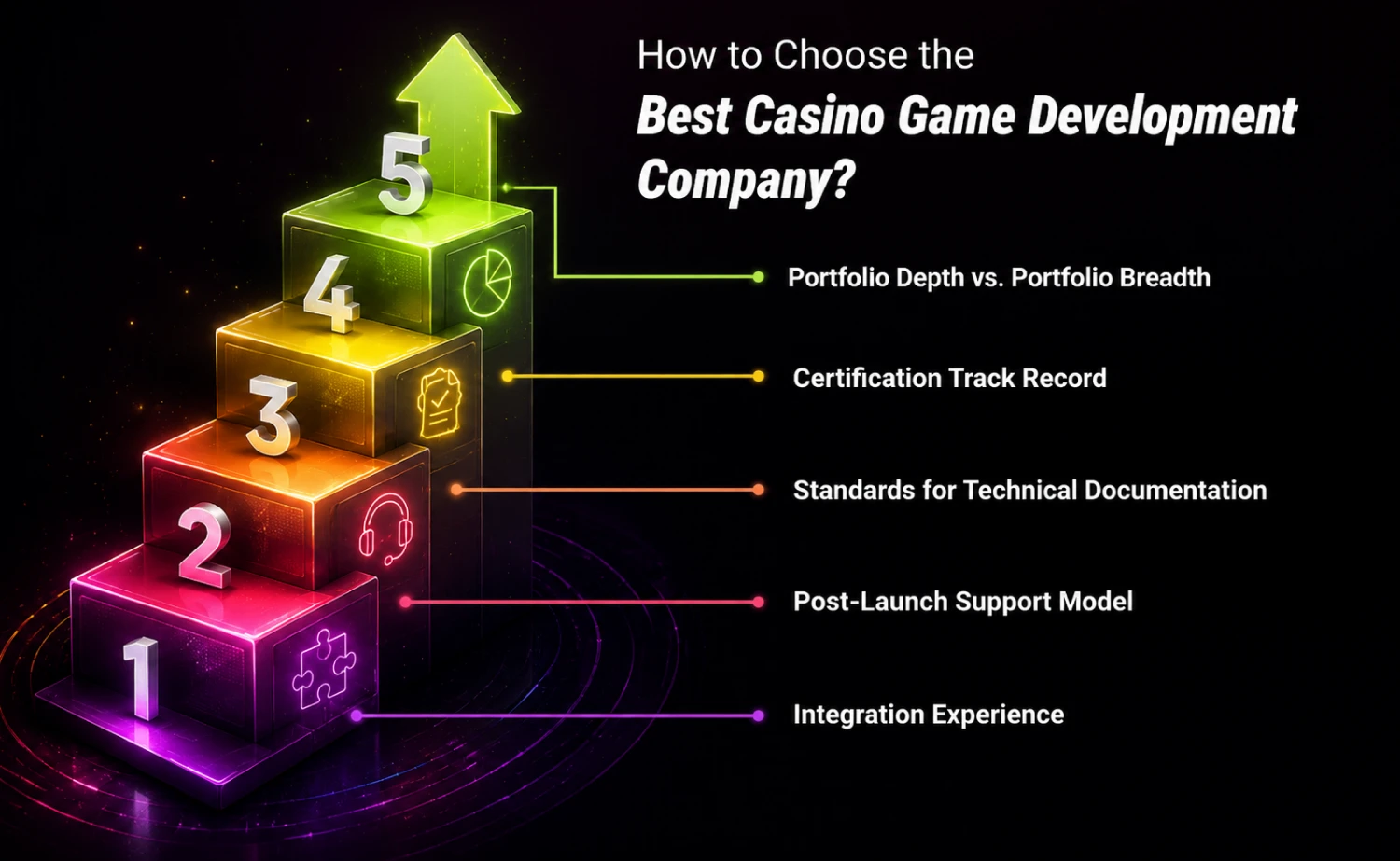
Choosing a development partner is less about who can build a game and more about who can build a game that survives certification, integrates cleanly, and performs commercially. Most evaluation processes focus on surface signals.
A large portfolio of casino and slot games does look impressive, but it doesn’t necessarily indicate the capability of the game development company. Within their portfolio, check for;
Casino game development studios that use templates to build casino games will show breadth, but the ones that understand the systems will always focus on showing depth.
Check or ask which labs they have worked with? (GLI, eCOGRA, iTech Labs) or which jurisdictions have they delivered to? This will help determine how well they understand compliance requirements and, more importantly, how likely they are to avoid certification delays.
Serious and experienced casino game developer teams can show you three things without asking;
If not, ask for these before signing any contract, and if the documentation is vague at the beginning, it will remain inconsistent throughout the project and ultimately become a problem during certification.
Deployment is not the end of the relationship, and when choosing a casino game development company, evaluate their;
For studios where delivery is the finish line, operators often face long-term maintenance risks and issues in communication.
Ask for the casino game development team’s integration experience and ask specifically.
As integration is where several projects slow down, you need teams that can handle complexity and not just show experience. Naturally, a team that has shipped across multiple ecosystems reduces that risk significantly, so prefer choosing this team.
Building a casino game that launches is one milestone. Building one that performs, integrates cleanly, and scales across markets requires a different level of engineering discipline.
TIGGames approaches casino game development with a technology-first mindset:
The engagement process is structured to reduce risk early:
For operators evaluating their next move, the next step is not committing to a build; it’s clarifying the right approach.
Casino game development is the process of creating digital casino games like slots, poker, roulette, blackjack, and crash games with secure gameplay, RNG systems, and platform integrations.
The cost depends on game type, features, technology, design complexity, integrations, and compliance requirements. Custom casino games usually require a higher investment than ready-made solutions.
Casino game development timelines vary based on complexity and features. Simple games may take a few months, while advanced games with custom mechanics require more development time.
Developers use technologies like HTML5, Unity, C++, Java, Node.js, APIs, cloud infrastructure, and certified RNG systems to build scalable casino gaming solutions.
Casino games use certified Random Number Generator (RNG) technology and independent testing to ensure fair, transparent, and unpredictable game outcomes.
Yes, operators can develop custom casino games with unique themes, gameplay mechanics, branding, bonus features, and monetization model
Modern casino games should include secure payments, mobile compatibility, player accounts, bonuses, analytics, multiplayer options, and compliance features.
Choose a casino game development company with proven experience, technical expertise, regulatory knowledge, portfolio strength, and reliable post-launch support.
Yes, casino games can be built for Android, iOS, mobile browsers, and PWAs with responsive designs for smooth cross-device gameplay.
Key trends include AI personalization, blockchain gaming, crypto payments, provably fair games, live casino experiences, and immersive gameplay features.

TIGGames provides secure & scalable casino game development solutions ready for global markets.
© 2026 TIGGames | All Rights Reserved | Sitemap | Privacy Policy
Request A Demo
Get a quick look at your potential earnings. Answer four simple questions and see your projected revenue for year one.
Keep in mind, this quick analysis is a preliminary guideline meant to kickstart your detailed market research. Best of luck!
Enter your email to receive your full cost breakdown, including projected net revenue, operating margin, and editable line items for your own planning.
Your inputs are used only to generate and deliver your report and are handled in line with TIGCasino's Privacy Policy.