

Prish K is an iGaming expert with 8+ years' experience empowers operators with scalable sportsbook, casino, sweepstakes, and prediction market solutions.
(TL;DR)
Provably fair casino game development has become one of the most important innovations in online and crypto gaming. As players increasingly demand transparency and operators compete for trust-driven audiences, traditional “black box” random number systems are no longer enough. Instead, provably fair systems introduce cryptographic verification that allows users to independently confirm game outcomes.
For casino operators, this shift is not just technical—it is strategic. It directly influences player acquisition, retention, and credibility in the crypto gaming ecosystem. This guide explains how provably fair systems work, their architecture, benefits, challenges, and why they are becoming essential for modern casino platforms.

Provably fair casino game development refers to building gambling systems where every game outcome can be verified by players using cryptographic methods. Unlike traditional systems where randomness is hidden inside a server, provably fair models expose the logic behind each result in a secure and verifiable way.
At its core, the system ensures that neither the casino nor the player can manipulate results after a game round is completed. This is achieved using cryptographic hashes, pre-committed server seeds, player-generated client seeds, and incremental values called nonces.
A simple way to understand it is this: instead of trusting the casino, players are given mathematical proof that the outcome was fair.
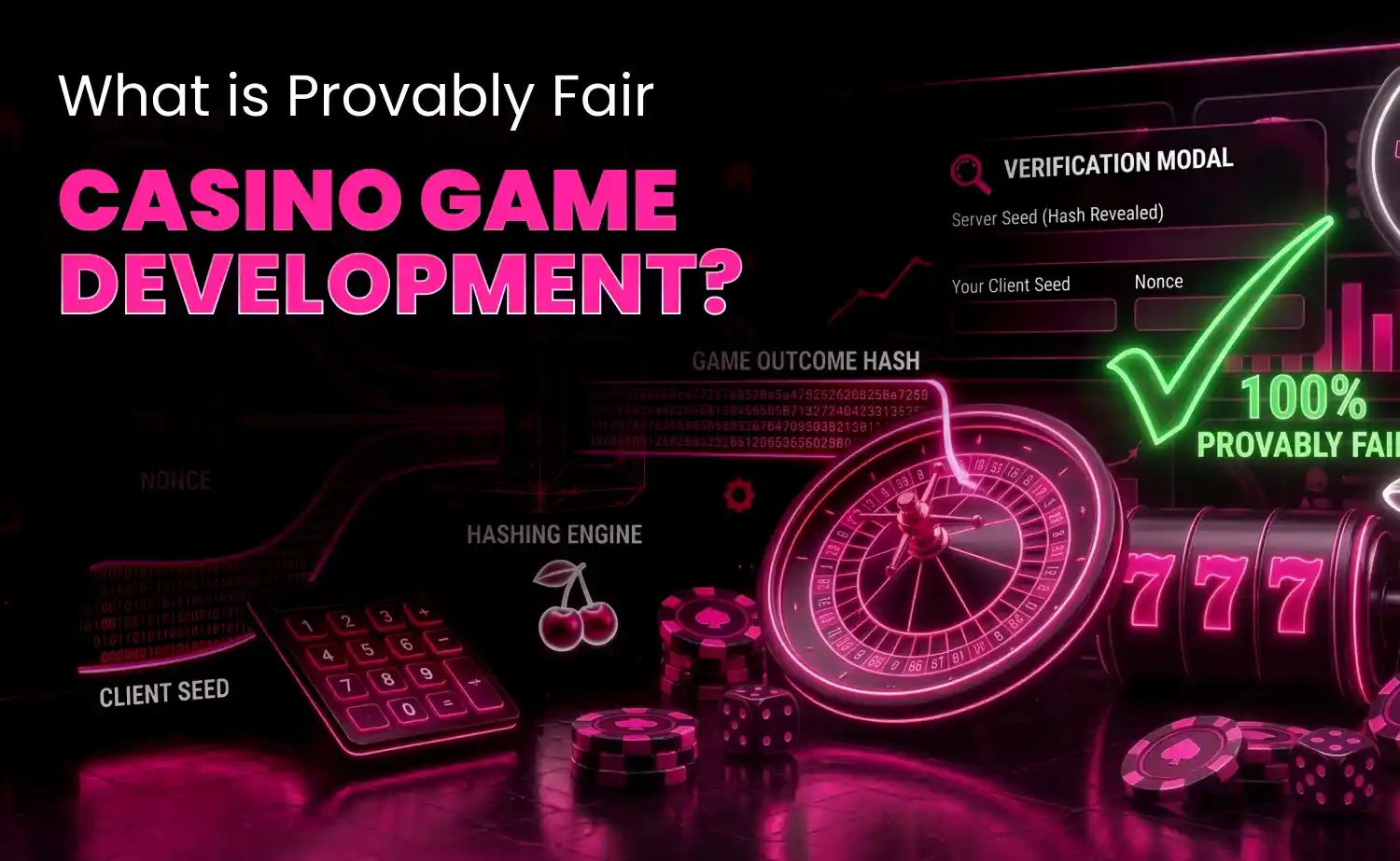
Provably fair systems rely on a structured combination of randomness inputs and cryptographic verification. The process is deterministic but unpredictable until the final reveal.
The client seed is generated by the player’s browser or device. It introduces user-side randomness into the game. Players can also customize it in many systems, ensuring that outcomes are partially influenced by user input.
The server seed is generated by the casino platform. Before gameplay begins, it is hashed using a cryptographic algorithm such as SHA-256 and shared in hashed form. The original seed remains hidden until the game round ends, preventing manipulation.
A nonce is a sequential number that increases with each bet or game round. Even if the same seeds are used, the nonce ensures every outcome is unique.
After the round is completed, the server reveals the original seed. Players can then verify whether the revealed seed matches the earlier hash. If it matches, the game is confirmed to be fair and untampered.
This entire structure is powered by cryptographic hashing systems such as SHA-256, which ensure data integrity and prevent reverse engineering of the original seed.
Traditional casino systems rely on centralized Random Number Generators (RNGs). These systems produce outcomes internally, without exposing logic to users. While regulated, they are often perceived as opaque.
| Aspect | Traditional RNG Systems | Provably Fair Systems |
| Outcome Generation | Generated internally on a centralized server | Generated using combined client seed, server seed, and nonce |
| Transparency | Opaque; logic is not visible to players | Fully transparent and mathematically verifiable |
| Trust Model | Players must trust the casino operator | Trust is replaced with cryptographic proof |
| Verification | Not possible for end users | Players can independently verify every game result |
| Manipulation Risk | Higher risk due to centralized control | Extremely low due to hashed seeds and verification logic |
| System Design | Closed system | Open, audit-friendly system designed for fairness |
| Use Case Fit | Traditional online casinos | Crypto casinos and Web3 gaming platforms |
Provably fair systems offer multiple advantages that directly impact both business performance and player experience.
First, they build trust. Players no longer need to rely on assumptions—they can verify every round themselves. This significantly reduces disputes and increases confidence in the platform.
Second, they enhance transparency. Every game round is backed by cryptographic proof, making manipulation nearly impossible without detection.
Third, they are naturally compatible with crypto ecosystems. Since blockchain users already value decentralization and transparency, provably fair systems align perfectly with their expectations.
Fourth, they improve retention. Players who trust a platform are more likely to return and continue playing over time.
Finally, they provide a strong competitive advantage in a crowded market where most operators still rely on traditional RNG systems.
Provably fair mechanics are most commonly used in fast-paced, outcome-driven games where transparency is highly visible to users.
Crash games are one of the most popular examples. These games involve multipliers that increase until a crash point, and players rely heavily on trust in fairness.
Dice games are another classic use case. Each roll is generated using seed-based randomness, making outcomes fully verifiable.
Mines games use hidden grid-based logic where players reveal tiles based on provably fair randomness.
Plinko games simulate ball drops through randomized paths, which can also be verified using cryptographic seeds.
These games benefit the most from provably fair logic because every result is immediate, visible, and frequently repeated.
Provably fair systems often integrate closely with blockchain infrastructure to enhance transparency and trust.
Wallet-based authentication allows users to connect using crypto wallets such as MetaMask or WalletConnect. This eliminates traditional login systems and aligns with decentralized identity models.
Smart contracts can be used to automate payouts, ensuring that winnings are distributed without manual intervention.
Some platforms also store game hashes or results on-chain, providing immutable records of gameplay history.
This combination of blockchain and provably fair systems creates a highly transparent gaming environment that is resistant to manipulation.
A robust provably fair casino platform typically includes several core technologies working together.
At the cryptographic level, hashing algorithms like SHA-256 are used to secure server seeds. A secure Random Number Generator ensures unpredictability in outcome generation.
Backend systems manage seed generation, nonce tracking, and verification APIs. These are often built using scalable frameworks such as Node.js.
On the frontend, real-time game engines deliver smooth user experiences, often using WebSockets for instant updates.
For blockchain-enabled platforms, Web3 libraries handle wallet connections, transaction signing, and smart contract interactions.
Together, these components create a secure, scalable, and transparent gaming ecosystem.
Security is one of the strongest pillars of provably fair gaming.
The system ensures RNG transparency by exposing how randomness is generated and allowing users to verify it independently. Since server seeds are hashed before gameplay, they cannot be altered without detection.
Anti-manipulation mechanisms include:
Verification tools are often provided within the casino interface, allowing players to input seeds and confirm fairness instantly.
Despite its advantages, provably fair development is not without challenges.
One major challenge is technical complexity. Implementing secure seed generation, hashing, and verification requires strong cryptographic expertise.
Scalability is another concern. High-traffic casinos must process thousands of verifications without slowing down gameplay.
User experience also plays a role. While transparency is important, overly technical explanations can overwhelm casual players.
Finally, blockchain integration can introduce cost and latency issues depending on the network used.
The future of provably fair gaming is closely tied to Web3 evolution.
Artificial intelligence will likely enhance fraud detection and behavioral analysis, complementing cryptographic fairness.
Decentralized casinos may eliminate central operators entirely, moving toward fully community-governed platforms.
Web3 gaming ecosystems will continue to merge NFTs, smart contracts, and provably fair logic into unified systems that redefine online gambling.
Casino operators are increasingly adopting provably fair systems for strategic reasons.
They provide a clear competitive advantage in crypto markets where transparency is highly valued. They also attract a younger, tech-savvy audience that prefers decentralized systems.
From a business perspective, these systems improve retention rates, reduce disputes, and strengthen brand credibility. In a trust-driven industry, these advantages directly translate into higher lifetime value per user.
Provably fair casino game development is no longer optional for operators targeting crypto and Web3 audiences—it is becoming the industry standard. Platforms that fail to adopt transparent gaming systems risk losing users to more trustworthy competitors.
TIGGAMES specializes in building provably fair casino platforms with secure RNG architecture, blockchain integration, and scalable game engines designed for modern gaming ecosystems. Whether you are launching a new crypto casino or upgrading an existing platform, provably fair systems can significantly strengthen your product’s credibility and performance.
If you are planning to build a transparent and future-ready gaming platform, now is the right time to invest in provably fair casino game development.
“Launch Custom Casino Games: Designed Around You”
European roulette has 37 pockets including a single zero, while American roulette has 38 pockets because it includes both 0 andProvably fair casino game development uses cryptographic algorithms, including server seeds, client seeds, and hashing mechanisms, to allow players to independently verify that every game outcome is fair and has not been altered. 00.
Provably fair technology is commonly used in Crash, Dice, Plinko, Limbo, Mines, Coin Flip, HiLo, Keno, Roulette, and other crypto casino games that require transparent and verifiable outcomes.
TIGGAMES develops custom provably fair casino games using secure cryptographic algorithms, certified RNG where applicable, blockchain integration, player verification tools, wallet integration, and scalable backend infrastructure.
No. Certified RNG is independently tested by accredited laboratories, while provably fair allows players to verify each game outcome using cryptographic proofs. Many operators combine both approaches to maximize transparency and trust.
Yes. Players can verify outcomes using the server seed, client seed, nonce, and cryptographic hash published by the platform. This verification process ensures the result was committed before gameplay and was not modified afterward.
Yes. TIGGAMES develops fully customized provably fair games with unique gameplay mechanics, branding, blockchain compatibility, cryptocurrency payments, smart contract integration, and cross-platform support.
Yes. Provably fair technology can complement regulatory compliance when combined with responsible gaming features, security controls, certification processes, and jurisdiction-specific licensing requirements.
Yes. TIGGAMES integrates Bitcoin, Ethereum, USDT, BNB, Solana, and other digital assets through secure wallet systems, enabling multi-currency gameplay and blockchain transactions.
TIGGAMES offers cryptographic verification, blockchain integration, provably fair algorithms, game mathematics, API integration, multiplayer capabilities, responsive HTML5 development, compliance support, QA testing, and post-launch maintenance.
TIGGAMES delivers end-to-end provably fair casino game development with transparent game logic, scalable architecture, blockchain expertise, custom game design, compliance support, and ongoing technical maintenance, helping operators launch secure and trusted gaming platforms.

TIGGames provides secure & scalable casino game development solutions ready for global markets.
© 2026 TIGGames | All Rights Reserved | Sitemap | Privacy Policy
Request A Demo
Get a quick look at your potential earnings. Answer four simple questions and see your projected revenue for year one.
Keep in mind, this quick analysis is a preliminary guideline meant to kickstart your detailed market research. Best of luck!
Enter your email to receive your full cost breakdown, including projected net revenue, operating margin, and editable line items for your own planning.
Your inputs are used only to generate and deliver your report and are handled in line with TIGCasino's Privacy Policy.