

Prish K is an iGaming expert with 8+ years' experience empowers operators with scalable sportsbook, casino, sweepstakes, and prediction market solutions.
(TL;DR)
Live casino game development typically costs between $10,000 and $500,000+ depending on game complexity, streaming infrastructure, customization, security requirements, studio setup, and deployment architecture.
Unlike traditional RNG-based casino games, live casino games require real-time video streaming, dealer management systems, low-latency communication, advanced backend infrastructure, and operational support. Whether you’re planning to launch live blackjack, roulette, baccarat, poker, or an entire live casino platform, understanding the investment involved is critical for effective budgeting and project planning.
This guide provides a complete breakdown of live casino game development costs, infrastructure expenses, studio setup investments, timelines, and cost-saving strategies to help operators make informed decisions.
The total development budget depends on the scope of the project, game complexity, and infrastructure requirements.
| Solution Type | Estimated Cost Range | Timeline |
| Live Casino MVP | $10,000 – $100,000 | 3–6 Months |
| Mid-Scale Live Casino Solution | $100,000 – $250,000 | 6–10 Months |
| Enterprise Live Casino Platform | $250,000 – $500,000+ | 10–18 Months |
These estimates typically include:
Every live casino project has unique requirements. A platform supporting multiple tables, custom dealer interfaces, advanced analytics, and high player concurrency will require a significantly larger investment than a basic MVP solution.

Several factors directly influence live casino software development pricing.
Different live casino games require different development efforts.
Examples include:
A simple roulette table typically costs less to develop than a feature-rich live game show that includes multiple cameras, animations, and interactive bonus rounds.
Streaming is the foundation of every live casino experience.
Development costs increase when implementing:
Many modern platforms rely on WebRTC technology to minimize delays and provide seamless player experiences.
A dealer management platform controls:
Custom dealer management tools increase upfront costs but improve long-term operational efficiency.
Additional features can significantly impact project budgets.
Popular examples include:
White-label solutions are generally more affordable than fully custom live casino environments.
Customization costs increase when businesses require:
Live casino platforms handle sensitive player and financial data.
Security investments often include:
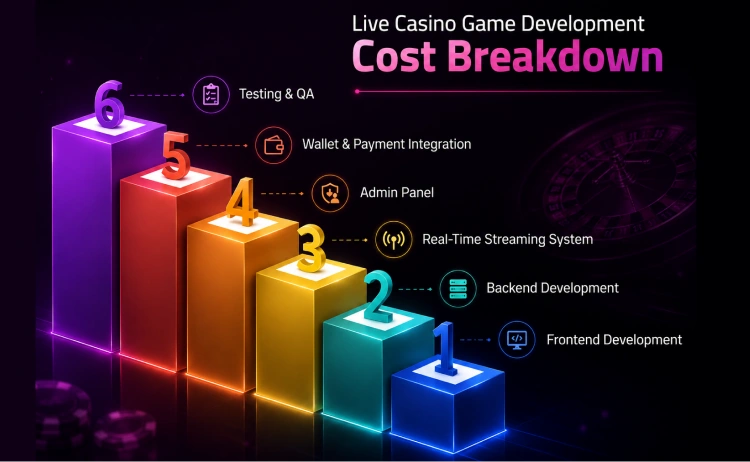
Understanding budget allocation helps businesses plan more effectively.
Frontend systems include:
Estimated Cost: $10,000 – $50,000
Backend infrastructure powers:
Estimated Cost: $20,000 – $120,000
Streaming infrastructure is often one of the largest cost components.
Typical expenses include:
Estimated Cost: $20,000 – $100,000+
Operators require complete control over gaming operations.
Key modules include:
Estimated Cost: $8,000 – $40,000
Wallet systems support:
Estimated Cost: $10,000 – $50,000
Live casino environments require extensive testing due to real-time interactions.
Testing typically includes:
Estimated Cost: $5,000 – $30,000
Different games require varying levels of development effort.
| Game Type | Estimated Cost Range |
| Live Blackjack | $50,000 – $120,000 |
| Live Roulette | $60,000 – $130,000 |
| Live Baccarat | $60,000 – $140,000 |
| Live Poker | $80,000 – $200,000 |
| Live Game Shows | $150,000 – $500,000+ |
Game shows generally require the highest investment because they combine streaming technology, custom game mechanics, visual effects, and advanced player engagement features.
Building an in-house live casino studio requires significant investment beyond software development.
Professional broadcasting often requires:
Estimated Cost: $5,000 – $50,000+
Essential equipment includes:
Estimated Cost: $10,000 – $100,000+
Professional environments require:
Estimated Cost: $10,000 – $150,000+
Dealer workstations often include:
Estimated Cost: $2,000 – $10,000 per station
Many businesses focus solely on development costs and underestimate ongoing expenses.
Cloud hosting costs increase as player traffic grows.
Video streaming consumes substantial network resources.
Third-party streaming infrastructure may involve recurring monthly expenses.
Ongoing support typically covers:
Most operators allocate 15–25% of initial development costs annually for maintenance and support.
Project scope directly affects both development time and overall investment.
| Development Phase | Duration | Budget Impact |
| Discovery & Planning | 2–4 Weeks | Low |
| UI/UX Design | 3–6 Weeks | Medium |
| Core Development | 8–20 Weeks | High |
| Streaming Integration | 4–8 Weeks | High |
| Testing & QA | 3–6 Weeks | Medium |
| Deployment & Launch | 1–2 Weeks | Low |
| Project Type | Timeline | Estimated Budget |
| MVP Live Casino Game | 3–6 Months | $50K–$100K |
| Mid-Scale Solution | 6–10 Months | $100K–$250K |
| Enterprise Live Casino Platform | 10–18 Months | $250K–$500K+ |
As a rule, projects requiring multiple game tables, custom dealer interfaces, advanced analytics, and high concurrency support require longer development cycles and larger budgets.
Many operators underestimate costs that emerge after the initial launch.
Depending on target markets, businesses may need:
Live casino operations require skilled dealers who must be trained to use the platform efficiently.
As player traffic increases, bandwidth and content delivery expenses can rise substantially.
Most successful operators maintain dedicated teams for:
Post-launch growth often includes:
Planning for these costs early helps avoid unexpected budget overruns.
One of the most common questions operators ask is whether live casino games cost more than traditional RNG games.
| Factor | Live Casino Games | RNG Casino Games |
| Development Cost | Higher | Lower |
| Streaming Infrastructure | Required | Not Required |
| Dealer Management | Required | Not Required |
| Operational Costs | High | Moderate |
| Scalability Complexity | High | Medium |
| Player Engagement | Very High | High |
| Revenue Potential | Very High | High |
While RNG games are typically cheaper to develop, live casino experiences often generate higher engagement, longer session durations, and stronger player retention.
Businesses must decide whether to build a custom platform or deploy a ready-made solution.
| Factor | Custom Development | Ready-to-Launch Solution |
| Initial Cost | Higher | Lower |
| Time to Market | Longer | Faster |
| Customization | Unlimited | Limited |
| Scalability | High | Moderate |
| Brand Differentiation | Strong | Limited |
| Ownership | Full Control | Vendor Dependent |
Custom development is ideal for operators seeking long-term competitive advantages, while ready-made solutions provide faster market entry with lower upfront investment.
Strategic planning can significantly reduce development expenses without sacrificing quality.
Focus on essential features such as:
Additional functionality can be added after launch.
Building modules independently allows businesses to scale features gradually rather than investing heavily upfront.
Many operators start with one or two live tables and expand as player demand grows.
Cloud-based environments eliminate large upfront hardware investments and provide flexible scalability.
Invest first in features that directly affect player acquisition, engagement, and retention.
“From Costs to Launch: Cost to Build Sweepstake Casino Games”
The global popularity of live dealer experiences continues to grow because they combine the convenience of online gaming with the authenticity of physical casinos.
Real dealers create a more immersive and trustworthy gaming environment.
Live interactions encourage longer gaming sessions and repeat visits.
Players often perceive live casino games as more transparent than traditional RNG-based games.
Operators can introduce:
These offerings can significantly increase player lifetime value.
TIGGAMES delivers scalable, secure, and high-performance live casino solutions designed for modern gaming businesses.
From concept to deployment, our team manages every stage of development.
We build low-latency live casino systems powered by modern streaming technologies and optimized network architectures.
Our solutions are designed to support growing player bases without compromising performance.
We implement enterprise-grade security measures to protect player data, transactions, and platform operations.
Whether you need a custom live blackjack game, a complete live casino ecosystem, or a ready-to-launch solution, TIGGAMES can tailor development to your requirements.
No two live casino projects have the same requirements. Development costs vary based on game type, studio setup, streaming infrastructure, player capacity, and business objectives.
Whether you’re launching a live blackjack table, a complete live dealer casino platform, or an innovative live game show, TIGGAMES casino game development company can help you define a realistic budget and development roadmap.
Contact TIGGAMES today to receive a customized live casino game development cost estimate and discover the most efficient path to launching your live gaming business.
Live casino game development typically costs between $10,000 and $500,000+, depending on game complexity, streaming infrastructure, customization requirements, and operational needs.
Major factors include game type, WebRTC streaming infrastructure, dealer management systems, studio setup, security requirements, wallet integration, and scalability goals.
Most projects require 3 to 18 months, depending on the number of games, level of customization, and platform complexity.
A professional live casino studio can cost anywhere from $25,000 to $300,000+, depending on equipment, design, camera systems, and streaming requirements.
Yes. Live casino games generally require higher investment because they involve real-time video streaming, dealer management systems, and ongoing operational expenses.
Yes. Ready-made platforms can significantly reduce upfront investment and accelerate deployment, although they typically offer less flexibility than custom-built solutions.

TIGGames provides secure & scalable casino game development solutions ready for global markets.
© 2026 TIGGames | All Rights Reserved | Sitemap | Privacy Policy
Request A Demo