

Prish K is an iGaming expert with 8+ years' experience empowers operators with scalable sportsbook, casino, sweepstakes, and prediction market solutions.
(TL;DR)
A recent Research and Markets report forecasts the global online gambling market to exceed USD 160.25 billion by 2031, with 10.58% CAGR by 2026-31. The report highlights that modern operators increasingly depend on API-based integration frameworks to connect game libraries, payment gateways, KYC providers, and compliance systems within a unified platform.
The online gambling industry has changed a lot from just having a single casino website. Now people who run casinos have to compete with others in a different way. Players want to be able to play thousands of games, have a real experience, be able to play on their phones, use cryptocurrency, play with live dealers and have everything work smoothly on all their devices.
To give players what they want the people who run casinos cannot just make their games or use separate systems that do not work together.
The casino games API integration is really important for the iGaming industry. If someone wants to start a casino with slots, live dealer tables or other games they need to use APIs. This makes it possible for them to grow their platform and add games.
For people who run casino businesses using API integration is not about the technology. It is also a decision that can affect how well their business runs, how many players they keep and how much money they make. It can even affect how well they compete with casinos in the long run.
This guide will explain how casino games API integration works and why it is important for B2B casino operators. It will also talk about the challenges and how businesses can build casino systems that work with many different game providers.

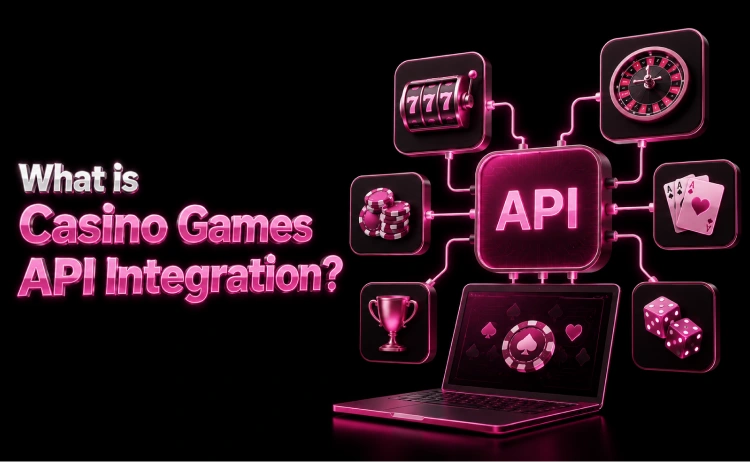
Casino games API integration refers to the process of connecting an online casino platform with external gaming systems through Application Programming Interfaces (APIs). APIs allow different software systems to communicate with each other securely and exchange real-time data.
In the iGaming industry, APIs act as bridges between casino platforms and third-party providers. Instead of building every game internally, operators integrate provider APIs to instantly access thousands of games and gaming services.
A modern casino platform may use APIs to connect:
This integration structure allows casino businesses to scale rapidly without rebuilding infrastructure every time they add new gaming content.
For example, when a player launches an online slot game, the casino platform communicates with the provider’s server through an API. The game loads dynamically, betting information is synchronized, and the player’s wallet updates in real time.
Without APIs, modern multi-provider online casinos would be almost impossible to operate efficiently.
The iGaming market is very competitive these days. Players want a lot of games to choose from. They want to be able to play on their phones without any problems. They want their money to move quickly. They want new things to play all the time.
The iGaming market and its players are pushing operators to do more. API integration is a help to operators because it lets them do what the iGaming market and its players want without slowing down.
One of the reasons operators use API integration is because it helps the iGaming market and its operators grow. If an operator had to make every casino game on their own it would cost a lot of money to hire people, like developers and designers and game mathematicians and compliance teams and infrastructure engineers.
API systems eliminate much of this complexity by allowing operators to integrate ready-made gaming ecosystems from specialized providers.
API-driven systems also improve speed-to-market. Instead of spending years developing game libraries from scratch, operators can quickly launch platforms with thousands of games already available.
This rapid deployment capability is especially important for:
Additionally, API integration improves platform flexibility. Operators can continuously add:
Without disrupting existing operations.
This flexibility is critical for long-term growth.
Casino API integration works through real-time communication between multiple systems.
A simplified architecture looks like this:
Casino Platform ↔ API Gateway ↔ Provider Servers ↔ Player Interface
When a player launches a game, the casino platform sends a request to the provider through the API. The provider authenticates the request, loads the game session, and continuously exchanges data with the casino platform during gameplay.
The API handles:
All communication happens within milliseconds to ensure smooth gameplay.
For operators, this architecture provides centralized control over multiple gaming providers while maintaining stable player experiences.
Modern casino ecosystems rely on multiple API categories working together simultaneously.
Slot game APIs are among the most common integrations because slots dominate the online gambling market. These APIs allow operators to add thousands of games from different providers through centralized infrastructure.
Live casino APIs connect platforms to real-time dealer studios offering games such as roulette, blackjack, baccarat, and poker. These integrations require high-performance streaming architecture and low-latency communication systems.
Sports betting APIs provide access to:
Payment APIs manage deposits, withdrawals, fraud prevention systems, and cryptocurrency transactions.
Wallet APIs synchronize balances across multiple gaming providers, allowing players to use a unified account across the entire casino ecosystem.
Each API category plays a critical role in creating seamless gambling experiences.
As casino platforms grow larger, integrating providers individually becomes increasingly complex. This is why many operators use casino game aggregators.
A casino aggregator is a centralized platform that provides access to multiple gaming providers through a single API integration.
Instead of connecting separately with:
Operators integrate one aggregator API that handles all provider communication.
This significantly reduces:
Casino aggregators have become extremely popular because they allow operators to scale rapidly while simplifying operations.
For growing casino businesses, aggregation systems often provide a more efficient expansion strategy than direct provider integrations.
One of the biggest advantages of API integration is operational scalability. Operators can continuously expand game offerings without rebuilding the platform architecture.
Another major benefit is content diversity. Players prefer casinos with large game libraries and multiple gaming categories. APIs help operators offer:
Within one ecosystem.
API integration also improves operational efficiency because centralized systems simplify wallet management, bonus distribution, analytics tracking, and reporting.
For operators entering international markets, APIs support:
This flexibility helps casinos scale globally.
Although APIs simplify expansion, integration still involves several technical challenges.
One major issue is provider compatibility. Different providers use different API standards, authentication systems, and data structures. Operators must ensure all systems communicate properly across the platform.
Latency optimization is another critical challenge. Casino games require real-time communication, especially in live dealer and multiplayer environments. Poor API performance may create:
Security is equally important because casino APIs handle sensitive financial and user data. Operators must implement strong encryption systems, secure authentication methods, fraud prevention tools, and DDoS protection.
Compliance complexity also increases when operating across multiple jurisdictions. API systems must support:
Managing these requirements requires experienced development teams.
Security is one of the most important aspects of casino API integration because gambling platforms process large volumes of financial transactions daily.
Operators must secure:
Modern casino APIs typically use:
Operators should also follow the OWASP API Security Top 10 to mitigate common API vulnerabilities during development and deployment.
Without strong security infrastructure, casino platforms face risks such as:
Strong API security directly affects player trust and platform reputation.
Blockchain technology is rapidly transforming casino API ecosystems.
Modern gambling platforms increasingly integrate:
Crypto API integration allows operators to support:
This technology improves transaction speed, transparency, and global accessibility.
Crypto gambling is becoming one of the fastest-growing sectors within the iGaming industry.
The future of casino API infrastructure is moving toward highly scalable, cloud-native ecosystems.
Artificial intelligence is being integrated into API systems for:
Real-time multiplayer systems are also becoming increasingly important as operators focus on social gambling experiences.
Cloud infrastructure will continue improving:
As the industry evolves, APIs will remain central to casino platform architecture.
For B2B operators, API integration is not just a development process—it is the foundation of scalable casino operations.
A strong API ecosystem helps businesses:
Without modern API infrastructure, casino platforms struggle to compete in today’s fast-moving iGaming market.
As player expectations continue increasing, scalable API-driven ecosystems will become even more important for long-term success.
Building scalable casino ecosystems requires advanced API architecture, secure wallet systems, multi-provider compatibility, blockchain integration, and enterprise-grade infrastructure.
TIGGAMES specializes in casino games API integration, multi-provider game aggregation, live casino infrastructure, blockchain gaming systems, and scalable iGaming platform development for global operators. From unified wallet integration to enterprise-level casino ecosystems, TIGGAMES helps businesses build secure and high-performance gaming platforms designed for long-term growth.
Casino games API integration connects online casino platforms with external gaming providers to deliver games and gaming services through real-time communication systems.
Online casinos use APIs to add games, payment systems, live dealer content, wallet synchronization, and other gaming services quickly and efficiently.
A casino game aggregator is a platform that provides access to multiple gaming providers through one centralized API integration.
Yes. Professional casino APIs use encryption, authentication systems, fraud detection tools, and secure communication protocols.
Yes. Modern casino APIs commonly support cryptocurrency wallets, blockchain payments, and provably fair gaming systems.
Major challenges include provider compatibility, latency optimization, compliance management, security implementation, and wallet synchronization.
Scalable APIs allow operators to add new providers, games, payment systems, and gaming features without rebuilding platform infrastructure.
Casino APIs commonly use REST APIs, WebSockets, Node.js, cloud infrastructure, blockchain systems, and secure wallet architecture.
Yes. Live casino APIs connect operators with real-time dealer studios and streaming-based gaming systems.
Aggregator APIs simplify infrastructure management and provide faster access to multiple gaming providers through a single integration.

TIGGames provides secure & scalable casino game development solutions ready for global markets.
© 2026 TIGGames | All Rights Reserved | Sitemap | Privacy Policy
Request A Demo
Get a quick look at your potential earnings. Answer four simple questions and see your projected revenue for year one.
Keep in mind, this quick analysis is a preliminary guideline meant to kickstart your detailed market research. Best of luck!
Enter your email to receive your full cost breakdown, including projected net revenue, operating margin, and editable line items for your own planning.
Your inputs are used only to generate and deliver your report and are handled in line with TIGCasino's Privacy Policy.