

Prish K is an iGaming expert with 8+ years' experience empowers operators with scalable sportsbook, casino, sweepstakes, and prediction market solutions.
(TL;DR)
The global casino-grade playing cards market was valued at $2.8 billion in 2025 and will bring about $4.7 billion in 2034, along with 6% growth. The maximum market share, 42.3%, was occupied by plastic cards, and the leading region was North America, with 38.6% of the revenue worldwide. Investments in casino infrastructure and the development of gaming tourism and home-based gaming attracted the interest of major manufacturers. The company Cartamundi holds the largest market share, showing the largest growth rate, the largest number of partnerships, and distributes in over 150 countries.
Casino card games, be it online or offline, have always been a staple form of entertainment for gambling enthusiasts. Sporting classic themes such as blackjack or poker, these games are always readily available. Card games are captivating due to their straightforward nature combined with player agency and competitiveness.
And for iGaming operators developing any traditional card game for a casino (online or offline), a multitude of other factors come into play. Consideration has to be given to the logic of the game, probabilities that may come into play, integration into the platform, security, and the regulations and restrictions of the applicable market.
A good card game will allow further flexibility while maintaining a fun and immersive experience for the player. This will allow the operator to use the game as a canvas for future ideas and innovations.
This casino game development guide will highlight the most relevant features/contact points for operators who will be developing card games.
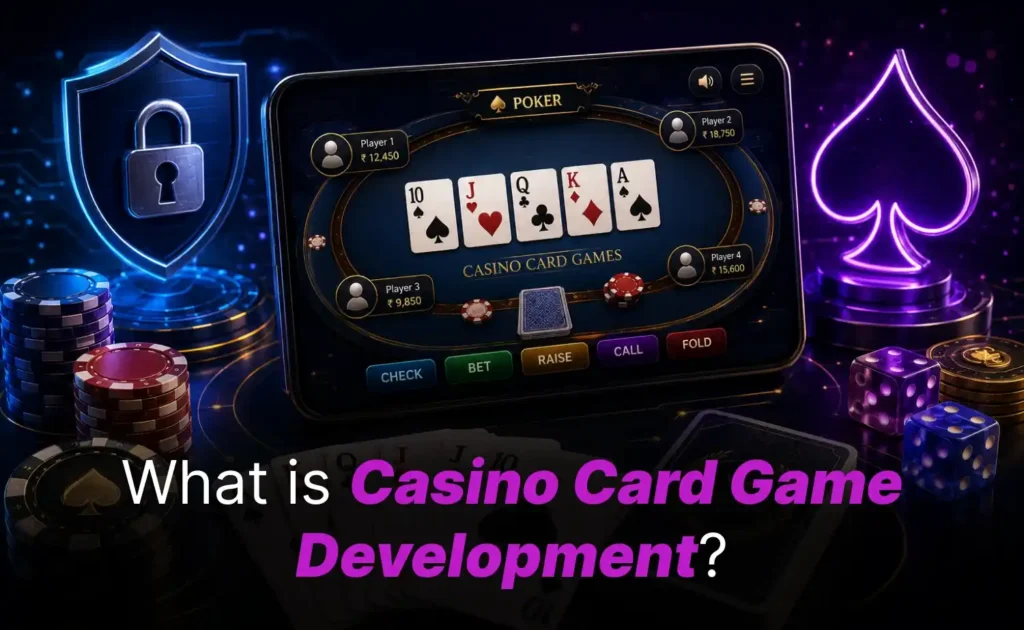
Casino card game development involves building digital card games for online casino platforms across web and mobile. Operators can choose proven formats like blackjack game and baccarat game or create original games with custom rules and mechanics.
The development process typically covers:
Every game type has unique technical needs. A betting platform for single-player blackjack and one that provides players the ability to play multiplayer poker games will require different technical components for setup.
Depending on the target market, goals, and platform strategy, iGaming operators will require unique card game solutions. Operators can select from fully customized casino game solutions to game solutions that can be deployed instantly and everything in between.
| Solution | Description |
| Custom Casino Card Game Solution | Create original card games with unique rules, branded gameplay, custom themes, and tailored mechanics to offer a differentiated player experience. |
| Ready-to-Launch Card Game Solution | Deploy market-ready card games with proven gameplay mechanics, optimized performance, and essential integrations for faster platform expansion. |
| Multiplayer Card Game Solution | Enable real-time player competition with features such as live tables, matchmaking, tournaments, rankings, and interactive gameplay. |
| Real Money Card Game Solution | Build secure betting-based card games with wallet connectivity, transaction management, responsible gaming controls, and regulatory support. |
| Live Dealer Card Game Solution | Deliver immersive casino experiences with live dealer integration, video streaming, multiple tables, and real-time player interaction. |
| Branded Card Game Solution | Customize existing or new card games with operator branding, unique visuals, and personalized gameplay elements to strengthen market identity. |
Different card games require different technical approaches. The table below highlights common considerations before starting development.
| Casino Card Game | Gameplay Style | Development Requirements |
| Blackjack | Player versus dealer gameplay with strategic decisions | Requires accurate RTP calculation, rule configuration, RNG integration, and betting logic. |
| Baccarat | Simple betting format based on player, banker, and tie outcomes | Focuses on smooth gameplay flow, table variations, and premium user experience. |
| Poker | Multiplayer competition with player interaction | Requires real-time servers, matchmaking, tournament systems, and security controls. |
| Teen Patti | Fast-paced regional card game format | Needs localized rules, mobile optimization, and social gaming features. |
| Andar Bahar | Prediction-based card gameplay | Requires simple mechanics, fast loading, and optimized player flow. |
| Custom Card Games | Unique operator-created gameplay | Requires custom development, testing, and flexible backend architecture. |
Mathematics forms the foundation of every casino card game. It defines probabilities, payouts, RTP, and house advantage.
Before launch, operators need to evaluate:
A poorly designed mathematical model can affect both player trust and long-term revenue.
For digital card games without live dealers, RNG determines card outcomes.
A properly implemented RNG system helps ensure:
Operators entering regulated markets generally require independent testing and certification from recognized gaming laboratories.
A basic card game may attract initial players, but additional features help improve retention.
Multiplayer gameplay creates a more interactive experience by allowing players to compete with others.
Common features include:
Competitive formats encourage repeat visits.
Operators can introduce:
Player data can help operators provide more relevant experiences through:
A reliable technical foundation is required to support performance and security.
The game engine controls:
The backend manages:
Real-money card games require secure payment handling with support for:
APIs allow card games to connect with casino platforms, aggregators, payment systems, and analytics tools.
Compliance requirements depend on the target market, but operators usually need to address:
Building compliance into the initial development process reduces delays during certification and market launch.
Casino card games generate revenue through different models.
Traditional betting models allow operators to earn through house edge or platform fees.
Premium players can be targeted through:
Poker-style tournaments can create additional revenue through entry fees and promotional events.
Operators can introduce branded tables, themes, and special gameplay options to improve monetization.
Operators need to maintain fair gameplay while ensuring the game remains commercially sustainable.
Games should perform consistently across mobile devices, desktops, and different operating systems.
Each market may have different technical and compliance requirements, making flexible development important.
Regular updates, promotions, and new features help prevent player interest from declining after launch.
The first step concerns the format of the game, the rules of the betting and the game, and the step in which the players are involved. Here, operators define whether they want their game to be a standard offering of a card game, e.g., blackjack, or if they want a card game offering to be more tailored.
The design of the game is driven by the math that describes the mechanics and fairness of the game from the perspective of the players, and the return to the business in which the operators are involved.
The game’s tech stack describes the game’s mechanics and business drivers, and supports the design and development of the player experience and transactional environments.
Engagement and retention can be engineered via the incorporation of things like gaming tables, deals, or player participation that supports loyalty.
The design of the game must be tested for fairness, security, compliance, and performance, and will be a focus post-launch to optimize.
Casino card game development involves expertise in multiple disciplines, including technology, math, game design, and regulations. For customizable card game development solutions for online casino platforms, TIGGAMES supports iGaming operators.
TIGGAMES covers the entire development life cycle from game logic to user interface development, backend systems, integration of random number generators, and testing and deploying the game within a shorter time frame. In addition, TIGGAMES develops card game systems that are customizable and adaptable.
Create customized card game experiences with reliable technology, flexible gameplay, and features designed to grow your casino platform.
The cost depends on the game type, platform support, customization level, multiplayer features, integrations, and certification requirements. A basic card game requires less development effort compared to a multiplayer casino platform.
Development timelines vary based on complexity. Games with custom mechanics, multiplayer features, and regulatory testing usually require more time compared to standard card game builds.
Popular online casino card games include blackjack, baccarat, poker, Teen Patti, Andar Bahar, and custom card-based games.
Yes. Digital card games commonly use RNG systems to generate unpredictable outcomes and maintain fair gameplay.
Yes. Operators can build custom games with unique rules, themes, betting systems, and branding.
In regulated markets, card games usually require testing and certification to verify fairness, security, and compliance.
Yes. Multiplayer card games can include live tables, matchmaking, tournaments, rankings, and player interaction features.
Development usually involves game engines, backend servers, APIs, databases, payment integrations, and security systems.
Features such as tournaments, loyalty programs, personalized rewards, and multiplayer experiences can help increase engagement.
A specialized development partner provides expertise in game mechanics, technology, compliance, and deployment, helping operators reduce development risks.

TIGGames provides secure & scalable casino game development solutions ready for global markets.
© 2026 TIGGames | All Rights Reserved | Sitemap | Privacy Policy
Request A Demo
Get a quick look at your potential earnings. Answer four simple questions and see your projected revenue for year one.
Keep in mind, this quick analysis is a preliminary guideline meant to kickstart your detailed market research. Best of luck!
Enter your email to receive your full cost breakdown, including projected net revenue, operating margin, and editable line items for your own planning.
Your inputs are used only to generate and deliver your report and are handled in line with TIGCasino's Privacy Policy.